

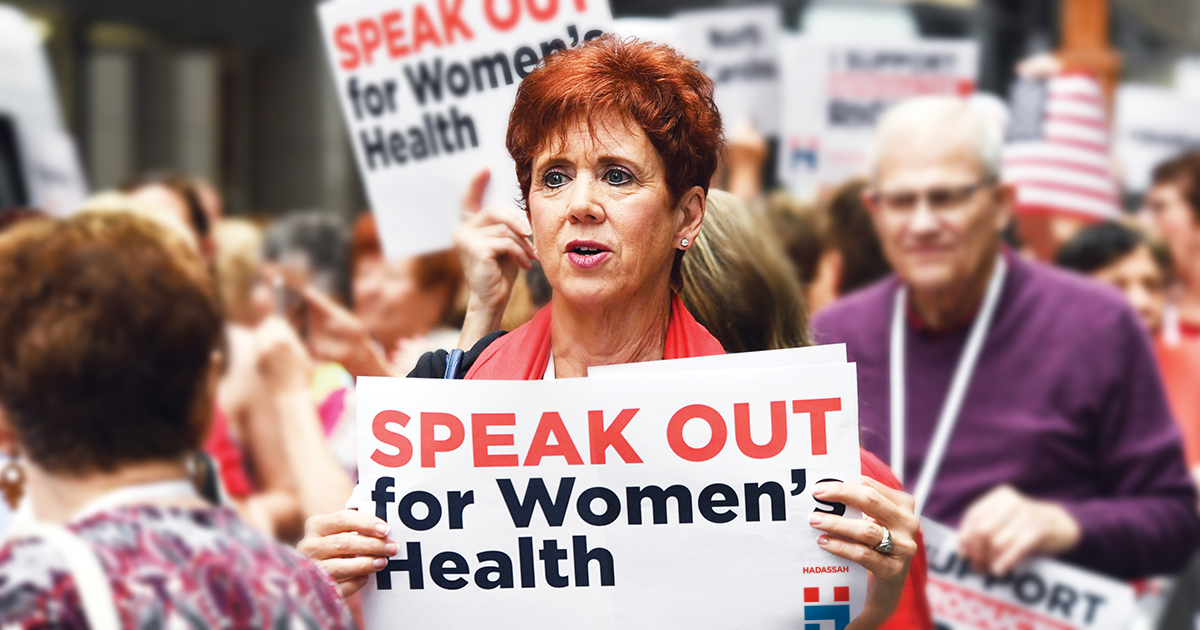
NEW YORK, NY – In recognition of National Women’s Health Week (May 10 – 16, 2026), The We Care US Organization of America, and 27 organizations join together to urge the
restoration of women’s health research funding and recognize the bipartisan leadership of
Senators Susan Collins and Patty Murray and Representatives Tom Cole and Rosa DeLauro in
championing increased funding for medical research to address pressing public health
challenges. As a global leader in biomedical research and innovation, the United States has made
exceptional advances in women’s health research and care over the last 30 years. However, the
decision to terminate federal funding for projects dedicated to women’s health is undermining this
progress and impacting the ability to study the unique health challenges faced by women.
Historically, women’s health has been underdiagnosed, underfunded and under-researched,
leaving significant gaps in women’s healthcare. In 1990, the National Institutes of Health (NIH)
Office of Research on Women’s Health (ORWH) was established and codified into law three years
later through the NIH Revitalization Act, mandating that women and minorities be included in all
NIH-funded clinical research. This was a critical step toward better understanding the differential
and disproportionate impact of certain diseases and conditions on women and was reinforced
through the establishment of The Specialized Centers of Research Excellence (SCORE) on Sex
Differences in 2002, which studies the role of biological sex differences on health.
Yet decades later, despite representing over 50 percent of the US population, women only
constitute 40 percent of participants in clinical trials for cancer, cardiovascular disease and
psychiatric conditions, three conditions that impact women the most.2 These gaps in funding mean
that treatments, diagnostics and clinical guidelines are often based on data that excludes or
underrepresents women. This underrepresentation has real, devastating impacts. The failure to
study medications and other interventions in a broad sampling of women has contributed to
women experiencing adverse effects from medications at twice the rate of men.3 At the same time,
less than half of NIH-funded studies analyze or report their findings by sex, limiting the ability to
understand how results may impact men and women differently.4
Investing in women’s healthcare and research has the potential to boost the global economy by $1
trillion annually by 2040.5 It is critical that Congress continue to fund research for conditions which
disproportionately impact women and ensure that women and men are represented equally in
clinical trials.
Disparities in biological sex appear in many areas affecting women’s health. Cardiovascular
disease, for example, is the leading cause of death for women, impacting over 60 million women in
the US.6 Despite this, women still face delayed diagnoses, largely as a result of the lack of research
into the biological differences between how cardiovascular disease manifests differently in men
and women.7 Similar differences/disparities in biological sex exist in the screening, diagnosis and
treatment of other diseases, including cancer, Alzheimer’s and many autoimmune diseases.
Without continued research and funding, these gaps will only be exacerbated.
Additionally, women in the US continue to face significant reproductive and maternal health gaps in
diagnosis and care. The US has the highest rate of maternal deaths of any high-income nation, 80
percent of which are likely preventable.8 Endometriosis, a condition which affects approximately
6.5 million people in the US, was misdiagnosed as another health condition in over 75 percent of
women.9 Alarmingly, menopause, a stage of health which will impact half of the population, is not
properly considered in 99 percent of preclinical aging studies.10 In 2025, the Senate advanced
legislation with bipartisan support to expand menopause research at the Department of Veterans
Affairs and the Department of Defense. This measure was stripped out of the final version of the
National Defense Authorization Act, leaving this stage of life critically understudied. For the wellbeing of all women, it is crucial that funding be restored to maternal and reproductive health
initiatives.
While there are still improvements to be made, research which includes women and focuses on
how health conditions manifest differently in men and women, has pushed forward lifesaving
advances in recent years. For example, robotic surgery has been introduced to complete coronary
bypass surgery on women, who tend to have smaller arteries.11 Research, which has led to earlier
detection and more effective therapies, has resulted in the breast cancer death rate decreasing 44
percent from 1989 to 2022.12 These are just a few of the vital advances in women’s health that have
been made possible as a result of funding for women’s health research.
Current research in the areas of maternal health, cancers specific to women, such as cervical and
breast cancer, mental health, eating disorders, sexually transmitted diseases that affect women,
vaccines and pregnancy, and much more continues to be critical and we urge continued robust
investment in these areas of research. While we were glad to see funding restored last year for the
Women’s Health Initiative (WHI), a longitudinal study that began in 1992 and involved over 161,000
participants, we have witnessed an alarming reduction in funding for women’s health studies.
In Fiscal Year 2025, there was a 31 percent drop in the number of projects funded in 2025 that
included the word “women.”13 Among the woman-focused research grants that were canceled in
2025 was a grant on the structure and growth of uterine fibroid tumors, which affect up to 80
percent of women by the time they reach age 50.14 Funding was also eliminated for another multi
year study examining how social isolation, loneliness and barriers to care and support services
affect the brain and associated risk of developing Alzheimer’s15 – a disease whose patients are
nearly two-thirds women.16
Without sustained funding, these critical studies cannot continue, threatening to reverse the hard
won progress that researchers have made and placing lives and future medical breakthroughs at
risk.
We are grateful to Senators Susan Collins and Patty Murray and Representative Rosa DeLauro for
stepping forward and speaking out about the critical need to restore funding to ensure that
women’s health outcomes do not suffer. We would also like to thank Representative Tom Cole for
his historic efforts to secure increased funding for the NIH, including for Alzheimer’s and dementia
research, and to support biomedical research around this urgent public health issue.
We reinforce their calls to restore funding and urge Congress to act swiftly to restore and
protect robust funding for research that studies women’s health and the ways conditions both manifest differently in women and men, and the ways women and men respond differently to
treatments. Ongoing women’s health research funding is essential to ensuring that the
progress we have made in improving women’s health outcomes over the past 30 years does
not regress. Women across the nation are counting on you to protect their health and
wellbeing.